
Hunting for Haunting Ground
Published on 2026-07-09
Did you ever play Haunting Ground? Statistically, you probably didn't---I definitely didn't. A 2005 Capcom horror game that wasn't Resident Evil 4, Haunting Ground was met with middling reviews and sales, selling around 60k copies total between Japan and the US1 . Without a release on modern consoles, it has largely been remembered as curio of the PlayStation 2-era in the United States---its astronomical collector's price making it inaccessible to most would-be players. My local game store had exactly one copy that sat in a case for over a decade, steadily increasing in price as its eBay listings soared.
Finding myself in Japan recently, I had the idea for my first post on Cursed Cartridge Club to be a search for a playable copy of Haunting Ground, or Demento as it's known there. While I couldn't justify the outrageous second-hand market at home, I wondered if my luck might be better in Tokyo.
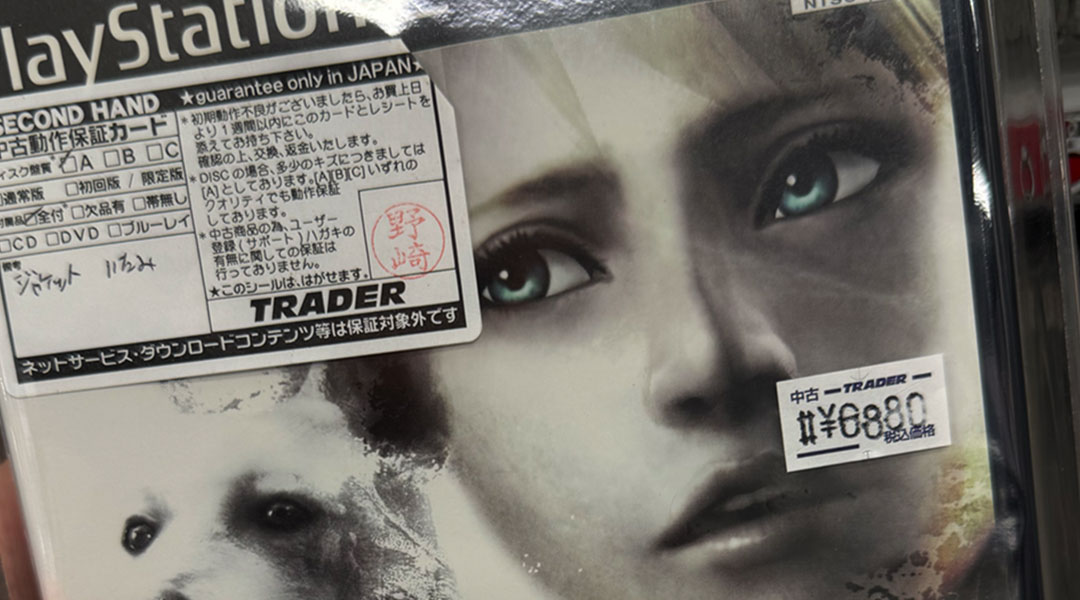
I began my search by walking from my hotel in Ueno to Akihabara. The first stop on my quest was the towering, multistory game and hobby shop Trader Akihabara. Somehow avoiding distractions, I made a beeline for the PlayStation 2 section on the second floor, went through my syllabary.... and promptly found it. It was there on my first try. Not only was it there, but it was ¥6,880 yen, or around $45 USD, a fraction of what North American copies go for.
There's a temptation by foreign writers to wax poetic about Japan as the last bastion of physical media---the mythical place where people still buy CDs---but I think it would be more instructive to highlight how vanishingly few options we have to play certain games. While I've been able to play Haunting Ground's much more popular contemporary, Resident Evil 4, on every console I've owned since the original GameCube, I would not be able to play Haunting Ground in 2026 without either shelling out hundreds of dollars on eBay or otherwise boarding a plane to fly across the world to buy a copy for now-vintage hardware. Video games have an access problem.
This is an extreme example, but it brings Sony's recent declaration that it will cease physical PlayStation disc production in 2028 into sharp relief. Without putting too fine a point on it, moving all sales to digital on PlayStation means that the only way to buy games is from the PlayStation Store, giving Sony complete control over what is available and at what price. While there has been a lot of data and opinions already shared on why such a monopoly risks pricing players out of the hobby entirely, it also has the side effect of making Sony an accidental purveyor of taste.
We got a preview of how this might work on the PlayStation 3 when an update removed backward-compatibility with PS2 and original PlayStation games. This broke the accepted cycle of trading a console in to the neighborhood game store towards paying for the next generation. Now if you wanted to play an older game, you had to either hold onto your old hardware, or re-purchase the game digitally from the then-new PlayStation Store---if it was available. There are many factors that can contribute to a game being omitted from the library, including lost assets and expired licenses (pour one out for 1998's Parasite Eve), but there is also an inherent cost that publishers might not find worth the squeeze.
If there is only one way to reach players on the console, publishers will inevitably take fewer risks. The genre-defining Resident Evil 4 will continue to be in demand until the heat-death of the known universe, but a game like Haunting Ground with its small original install base, female protagonist, and off-kilter story is less of a sure-bet. If a majority of players aren't buying new games,2 and if all games are competing for visibility in a single storefront, why would a publisher like Capcom put the resources into making Haunting Ground accessible when they would have to pay Sony at least 30%3 of what little profits they earn from a 20 year old game no one played the first time?
We have left the preservation of video games to the companies that own them, and access to games and their history is tied to economic means. As someone who grew up with the internet, this runs counter to utopian digital future I was promised---a vast resource of human history and information at our fingertips. Where other mediums like books and films have undergone their own struggles to be digitized en masse for preservation, games began with the computer, and that computer has only become more compact and accessible. We have infinitely more ways to store and retrieve the bits and bytes that make up a game like Haunting Ground. Ideally, our march towards an all-digital future would include something like Libby or Kanopy for games---library services that give card-holders free access to ebooks, audiobooks, and streaming movies. Nevertheless, a perfect storm of monopolies and bullish copyright lawyers means this has not been the case. Despite the technology, access to art is still intrinsically tied to profit, and will continue to be so for the foreseeable future.
Footnotes
-
VGChartz has it at only about 30,000 units in the US while NicheBarrier tracks similar numbers for Japan ↩
-
Circana’s Mat Piscatella shared some findings from their Q3 2025 Future of Games survey on Bluesky last October. The public information does not reveal the reason for 33% of gamers purchasing a new game less than once per year, but we can surmise it’s a confluence of raising costs and shifts towards forever games like Fortnite and Roblox. ↩
-
Price Breakdown Of A $70 Video Game: Digital Vs Physical provides an insightful breakdown in just how much both the console makers and publishers can earn per game on digital versus a physical release. Capcom would make even less percentage profit per-copy if the game was re-released physically. The digital profit sharing itself is strong on paper, but with fewer people buying games and less ways to buy them, I imagine the higher margins are necessarily on fewer different games. ↩